

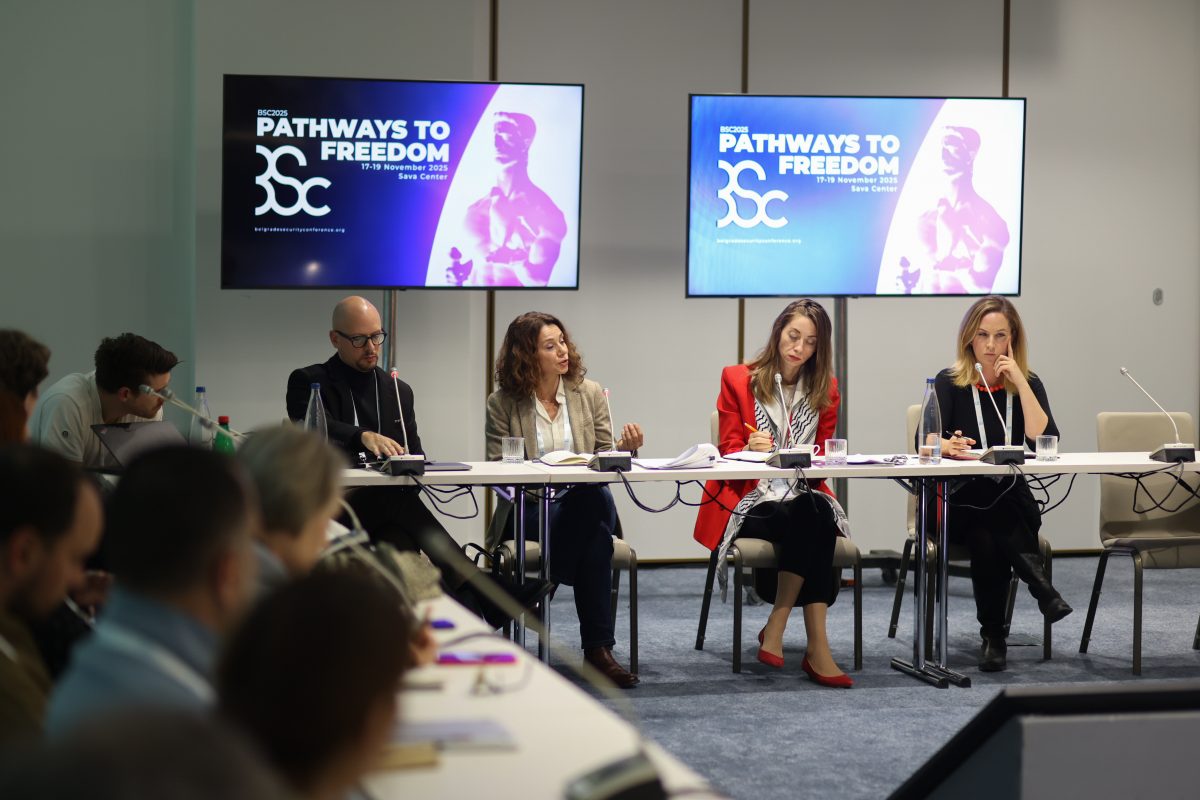
The panel Digital Repression and the Future of Civic Space focused on how spyware, cyberattacks, disinformation and legal loopholes are increasingly used to intimidate journalists, activists and ordinary citizens, shrinking democratic space across the region. All speakers agreed that these practices create a powerful chilling effect and that stronger safeguards, public awareness and institutional accountability are essential to protect fundamental rights.

The panel was moderated by Maja Bjeloš, Senior Researcher at the Belgrade Centre for Security Policy, who in her opening remarks highlighted the hostile digital environment in which civil society operates, noting state-sponsored attacks on media Južne vesti and KRIK, hacking attempts targeting BCSP, efforts to copy the conference website and the use of various spyware tools identified by Amnesty International.

Jelena Sesar, Researcher at Amnesty International, outlined the growing digital threats facing journalists, activists and civil society in Serbia. She explained that authorities rely on two models of intrusive surveillance. The first involves advanced spyware such as Pegasus and Predator, which can remotely access phone’s camera or microphone and provide unrestricted access to personal data. The second is locally developed spyware used by state security services, which requires physical access to a device. Amnesty also documented the unprecedented use of Israeli technology to forcibly unlock phones, a tool meant for legitimate investigations but now repurposed against civil society. Alongside spyware, Sesar described the deployment of IMSI catchers – portable devices that mimic telecom antennas to get access to the individuals at protests. In response to a question from moderator Maja Bjeloš about how such repression affects everyday life, Sesar highlighted the profound psychological and practical consequences. Victims frequently report feeling violated, anxious and unsafe, often changing their behavior, withdrawing from activism or censoring themselves.

Filip Milošević, technologist at the SHARE Foundation’s Emerging Threat Lab, described how little is known about the full scale of spyware and forensic tool abuse in Serbia since the publication of the organisation’s initial report. He noted that investigators have not identified new confirmed cases, but this absence of evidence is far from reassuring. According to him, two explanations are possible: either the authorities paused the use of these tools after public exposure, or civil society lacks the technical capacity and resources needed to detect ongoing abuses. Milošević added that many detained individuals now avoid carrying their phones, showing that awareness has increased, while others had their devices deliberately broken or factory-reset — raising suspicion that forensic tools were used to extract data beforehand. When asked about strategies for protection, he stressed that building trust and cooperation among civil society organisations, media and citizens is essential. Without stronger networks, surveillance technologies only reinforce the power of those already in control and deepen the chilling effect on society.

Zuzanna Sielska, Assistant at the Research Center for Public Policy and Regulatory Governance at the University of Silesia, examined the growing threat of cyberattacks and hybrid interference, emphasising that the most dangerous attacks are often invisible. While some acts of sabotage have been successfully prevented, she warned that psychological operations and disinformation campaigns pose a far greater long-term risk. Describing a recent case in Poland, she explained how a series of drone attacks was immediately followed by an online wave of posts claiming they were carried out by Ukrainians, Russians or Belarusians. This deliberate mixture of truth and falsehood was designed to create confusion, provoke speculation about NATO’s response and weaken public trust. Discussing the consequences, she pointed to the information warfare that intensified after millions of Ukrainian refugees arrived in Poland. Thousands of online accounts, many traced back to Russia, pushed claims that Ukrainians were taking jobs or disrespecting Polish society, attempting to fuel resentment.

Dušan Pokuševski, Lawyer and Programme Director at the Belgrade Centre for Human Rights, explained that, unlike in some European countries, Serbian law does not explicitly recognise spyware as either legal or illegal, leaving a dangerous grey zone. Existing provisions on digital surveillance are, on paper, aligned with international standards, including requirements of proportionality and legitimate aim. However, what is missing is the rule of law in practice: institutions are not free or willing to act in accordance with these norms. Mr. Pokuševski stressed that surveillance contributes to a broader chilling effect. People are afraid of how their information might be used, and digital monitoring becomes just one element in a wider strategy of pressure on anyone critical of the government. He recalled attempts to use Pegasus against civil society activists in 2023, which forced them to completely change their communication habits. In his view, education is crucial: only when people understand their rights can they exert meaningful pressure on authorities that violate them.
As part of this collaboration, the Protocol for Digital Security and Response to Digital Attacks was also developed, further strengthening efforts to enhance digital safety and resilience.