

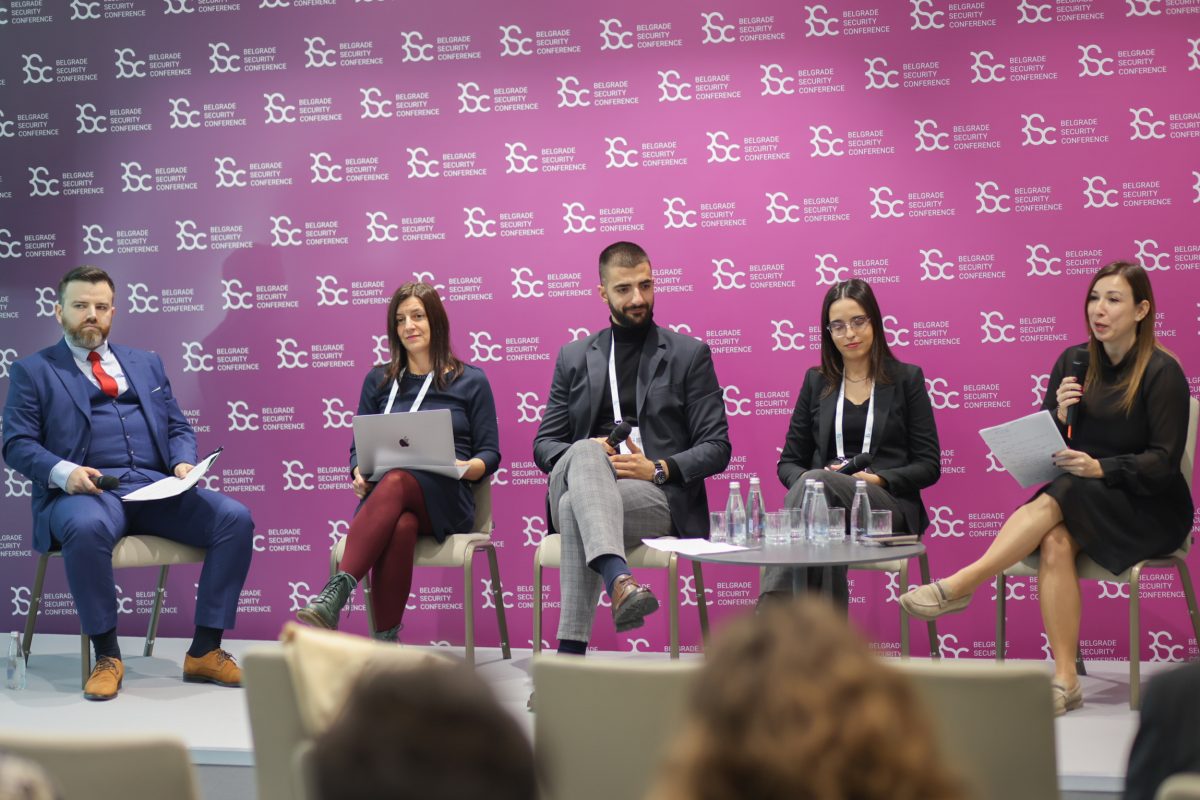
In an audience-inclusive discussion moderated by the Advocacy Director of the Lawyers’ Committee for Human Rights – YUCOM, Jovana Spremo, panelists representing Montenegro, Serbia, and Bosnia & Herzegovina, discussed the common challenges faced by human rights defenders in the Western Balkans.

Panelists agreed that governments often set obstacles for civil society organisations and employed subversive tactics meant to make activists’ lives more difficult. Additionally, participants agreed that smear campaigns were a tool employed often by authorities to discredit organisations. “Having trust in those who are defending your rights” said Spremo, “is the first step”.

Dejan Lučka, Director of the Banjaluka Centre for Human Rights, opened by saying that “the most dangerous thing is not a single law but the atmosphere which the law makes, even when struck down”. Lučka focused on the fact that governments, both in Republika Srpska and in the wider region, engender the concept of civil society organisations as potentially dangerous and normalise the idea of such groups are foreign mercenaries and lobbies. “Defenders have had to become very creative just to keep working” he concluded. “At any time, you can get a lawsuit filed against you.”

More transparency, demanded Ivan Radulović, Program Coordinator for Human Rights & Justice at Civic Alliance Montenegro. “We do seem to be frontrunners” conceded Radulović, “but there are still many concerns”. He also added that cooperation between NGOs from different countries in the region often goes as smoothly as possible, and that the problem lays instead with the relationships between NGOs and governmental institutions. Frontrunners or not, Montenegro still has a way to go—even after it has joined the EU. “We actually focus on what happens on the day after,” he concluded, “we become a member state”.

“GONGO organisations have been spreading across Serbia as well as phantom organisations – organisations that only exist on paper” – this is a big problem in Serbia, according to Alma Mustajbašić, a Public Policy Researcher at Civic Initiatives. GONGOs simulate dialogue and support for the authorities, she added. When government funds and support go to GONGOs, what can CSOs even do? “What is left for real civil society organisations”, emphasises Mustajbašić, “is real work on the field and with the communities, because this is how citizens can actually recognise who is doing the work”.

“When you do not have trust, you do not have society”. This was the conclusion of Tamara Filipović Stevanović, Secretary General of the Independent Journalists’ Association of Serbia. “The journalist community – real journalists – are human rights defenders”, Filipović Stevanović said, as opposed to journalists who only repeat after the government. Tamara also spoke on the threats and attacks made against Serbian journalists – whether the physical kind or the numerous spear campaigns that are published in matters of days, if not hours. “This is the worst year since 2008 for our journalists”, she said.

In the second part of the panel, panelists joined the audience in five smaller groups to discuss four different topics: security of human rights defenders, disinformation and smear campaigns, GONGOs and phantom organisations, and regional cooperation. Panelists and audiences agreed that solidarity and regional cooperation are very important, as is taking care of one’s own and each other’s mental health. “What is needed are media-literate people,” said Filipović Stevanović. “We should try to focus on initiatives that would gather youth and people from different countries from the Western Balkans,” added Radulović.