

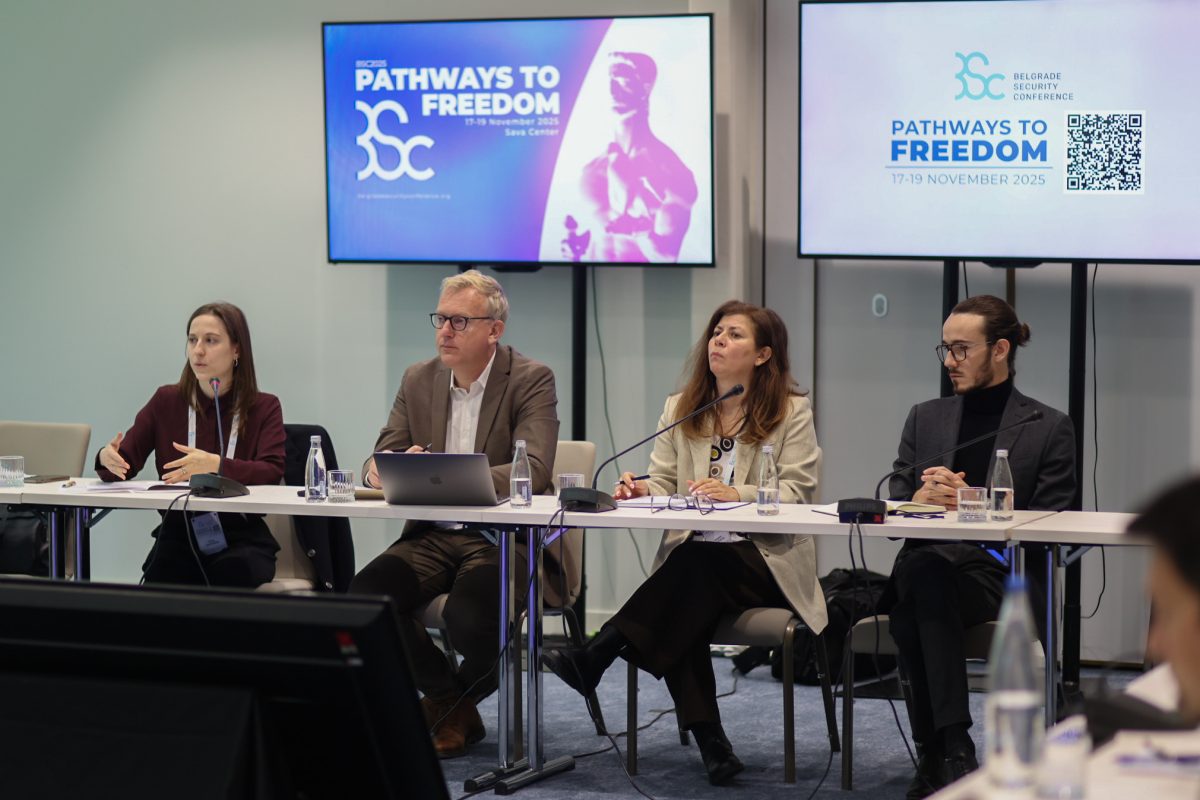
The panel “Recalibrating EU Support: Strengthening Candidate Countries’ Resilience to Malign Interference” examined how foreign actors exploit institutional weaknesses, economic vulnerabilities, and societal divisions in EU candidate countries – and how the EU can provide more effective support in countering these threats.
Speakers agreed that resilience must be built simultaneously at the institutional, economic, and societal levels, and that safeguarding democratic processes is inseparable from bolstering security and economic stability. The discussion was moderated by Steven Blockmans, Senior Fellow at CEPS and ICDS and Visiting Professor at the College of Europe.

Gergana Noutcheva, Associate Professor in the Political Science Department at Maastricht University, presented research demonstrating that malign interference systematically undermines democratic institutions in EU candidate countries, with Russia remaining the primary source of such activity. She explained that interference operates both through institutional channels, including election manipulation and support for political forces aligned with pro-Russian or illiberal agendas, and through societal channels aimed at eroding social cohesion and spreading narratives that challenge core democratic values. Countries heavily exposed to these threats, such as Moldova and Ukraine, have developed stronger resilience due to their frontline experience. Others, including Georgia and Serbia, show limited institutional resistance, particularly where ruling parties benefit from Russian support. Noutcheva stressed that building democratic resilience requires both institutional and societal components. Institutional resilience is easier to achieve when democratic governments are genuinely committed to protecting the system; in Serbia’s case, she argued, the framework exists on paper, but political leadership demonstrates little willingness to use it. Societal resilience, however, is far more difficult to build, especially because the EU remains an ineffective public communicator.

Fanny Sauvignon, Researcher in the Foreign Policy Unit at the Centre for European Policy Studies, addressed the socio-economic conditions that shape the resilience of candidate countries. She noted that their growth remains largely consumption-driven, while weak social safety nets and persistent brain drain undermine long-term development. She highlighted that external actors exert destabilising influence through strategic investment in critical infrastructure, through migration dynamics, and through the fuelling of corruption – all of which carry profound long-term consequences. Sauvignon emphasised that opening the single market and removing trade barriers would significantly strengthen economic stability, particularly when combined with efforts to reduce the heavy energy dependence of many candidate states. She also pointed to concerns about the under-absorption of EU funds, arguing for a sustained focus on building durable economic resilience and seeking long-term, practical solutions. In the short term, she recommended ensuring better access to EU loans so that candidate countries do not turn to China for financing, while maintaining conditionality as a core principle of such assistance.

Antoine Michon, Policy Officer at the Centre for Analysis, Planning and Strategy of the French Ministry for Europe and Foreign Affairs, argued that enlargement requires the EU to make a concrete commitment to strengthening its security community. He identified three key sectors where this transformation must occur. The first is economic security, an area where the Union needs a far more sophisticated agenda. The second is defence, which is particularly important for non-NATO candidates; Michon underscored the need to reinforce Europe’s defence capabilities, both for the present and the future, including through the development of integrated defence-industrial bases, while acknowledging that this sector poses sensitive challenges for enlargement due to existing screening mechanisms. The third sector concerns what he termed FEMI – Foreign Electoral Manipulation and Interference – a comprehensive “democracy shield” designed to counter attempts by foreign actors to undermine democratic processes. His proposal includes establishing a new centre for democratic resilience that would strengthen institutional capacities in candidate countries and foster greater citizen engagement. As he noted, “candidate countries’ security is EU security, even today.”

Responding to a question from the audience about whether enhanced defence cooperation could encourage member states to support enlargement – especially with regard to the defence capacities of Bosnia and Herzegovina and Serbia – Michon cautioned against expecting defence collaboration to shortcut the fundamentals of the accession process.