

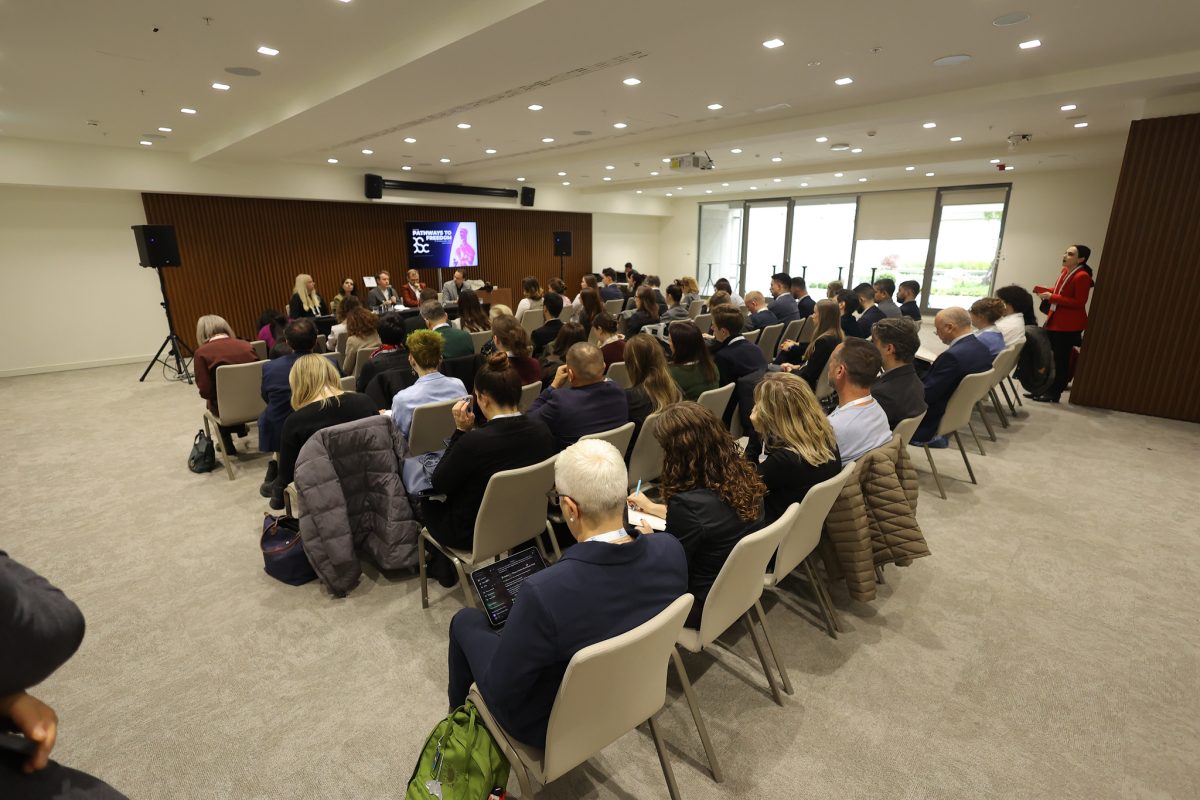
At the Belgrade Security Conference, the panel “Democracy Under Siege: The Rise of Anti-Establishment Extremism in Europe and Serbia” examined how anti-establishment narratives, conspiratorial thinking, and far-right activism are reshaping European politics and weakening democratic norms.

Moderated by Predrag Petrović, Research Director at the Belgrade Centre for Security Policy, the discussion emphasised that extremism today is not a fringe occurrence but a mainstream challenge that influences political communication, public attitudes, and institutional behaviour. Petrović opened by noting that anti-establishment parties in Europe now command close to 30% of support, compared to 12% in the 1990s. “This is no longer a marginal phenomenon,” he said. “These movements thrive on grievances and reject the foundations of democratic governance.”

Kacper Rekawek, Senior Research Fellow at the International Centre for Counter-Terrorism, described rising extremism across Europe, focusing on the Netherlands. “What we see is extreme populism — a revolt against the elite,” he said. While longstanding, social media and the COVID-19 pandemic significantly accelerated these dynamics. He outlined several Dutch factions- from conspiracy believers to radicalised farmers, emphasising their adaptability: “They are constantly searching for new topics that allow them to remain relevant.”

From Sweden, Morgan Finnsiö, researcher and investigative journalist at the Expo Foundation, argued that Nordic extremism mirrors broader transnational patterns. “Anti-establishment extremism looks remarkably similar across countries,” he explained. He highlighted the growing involvement of youth: “Extremists are getting younger, sometimes teenagers.” The 2022 Gotland killing, carried out by a former neo-Nazi influenced by U.S. conspiracy narratives, illustrated how extremist beliefs have entered the mainstream. “Right-wing extremism in Sweden continues to export neo-Nazi ideology across the region,” he added.

Turning to Serbia, Isidora Stakić, Senior Researcher at BCSP, outlined how extremist discourse intersects with state power. While fringe groups persist, she argued that the ruling Serbian Progressive Party (SNS) increasingly employs anti-systemic rhetoric. “The ruling party is becoming an extremist force,” she said. “Institutions violate basic human rights, loyalist groups attack protesters, and officials use hateful language to delegitimise the opposition.” She described this dynamic as transactional authoritarianism, where political loyalty is rewarded with impunity.

Aleksandra Bulatović, senior research fellow at the Institute for Philosophy and Social Theory and a well-known activist, stressed that extremism in Serbia is defined politically, not analytically. “Labels are imposed on activists, not on those who undermine institutions,” she said, highlighting the government’s “eco-terrorist list” targeting peaceful environmental protesters. “According to the authorities, an extremist is simply someone who refuses to be afraid.”
Bulatović argued for distinguishing extremism from legitimate radical activism: “Civil disobedience is democratic at its core. The misuse of these terms threatens civic space and undermines democratic capacity.”
Addressing a question about student protests, Stakić emphasised that criticizing an increasingly anti-systemic government is not extremism. “If the system produces extreme outcomes -inequality, erosion of rights – questioning it is legitimate,” she said.

The conversation also turned to foreign influences. Asked about Russia, Rękawek explained that pro-Kremlin narratives resonate with anti-establishment groups because “Putin is seen as someone who ‘breaks the system’.” Finnsiö added that foreign actors often only amplify existing domestic grievances: “It runs almost on autopilot. These movements look to each other across borders.”
Audience questions focused on the use of “family values” rhetoric, homophobia, and the merging of COVID-era radicals with traditional far-right actors. Finnsiö noted that European security agencies still lack consistent terminology: “Definitions matter – because loose definitions risk harming civil liberties.”
As the panel concluded, speakers agreed that anti-establishment extremism is evolving across borders and platforms, increasingly influencing mainstream politics. Democracy, they warned, is being undermined not only by fringe actors but also by political leaders who normalize conspiratorial and exclusionary narratives. Strengthening democratic resilience, they argued, will require clearer definitions, accountable institutions, and the protection of legitimate civic activism from politically motivated repression.