

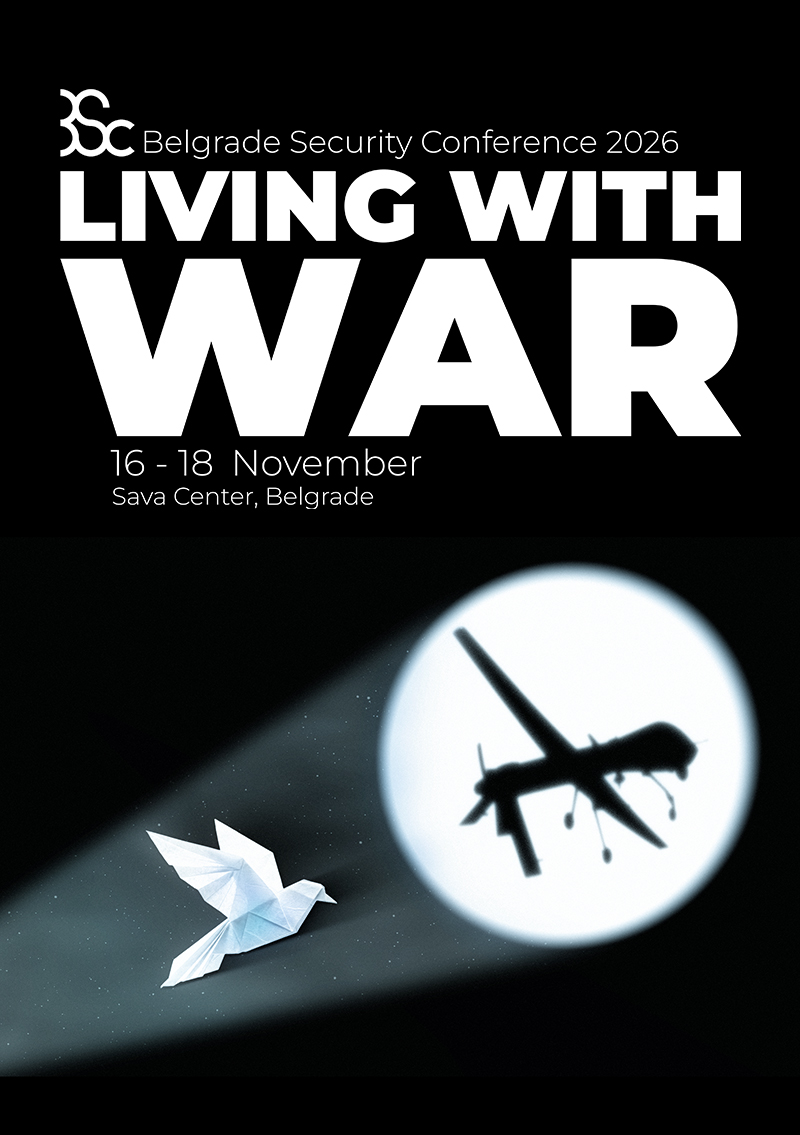
BSC2026
500+ participants / 80+ speakers
20+ panels and side sessions
Agenda
16-18 November 2026, Sava Center, Belgrade
16 November
16:00 – 17:00 Registration of participants
17:00 – 17:05 Introduction by the Masters of Ceremonies
Lejla Mazlić and Milan Šarić
17:05 – 17:15 Opening remarks
Srđan Cvijić, President of the International Advisory Committee of the BCSP
- 17:15 – 18:15 NATO 2030: Evolution Under Pressure?
NATO faces a defining strategic question: what will transatlantic security look like by 2030? Russia’s war against Ukraine has reaffirmed the Alliance’s central role in European security, while uncertainty over the long-term trajectory of U.S. engagement has intensified debates about Europe’s responsibility for its own defence.
Beyond familiar discussions on burden-sharing and defence spending lies a deeper political and strategic challenge. European allies increasingly recognise the need to assume greater responsibility and develop stronger capabilities, yet they continue to depend heavily on critical U.S. enablers, from intelligence and strategic lift to missile defence and nuclear deterrence. At the same time, Washington continues to call for a stronger European role while NATO remains fundamentally anchored in transatlantic interdependence.
By 2030, these tensions will become increasingly difficult to manage through gradual adjustment alone. Can NATO combine greater European responsibility with continued transatlantic cohesion? What would a different level or form of U.S. engagement mean for the Alliance? Can European allies develop the military capabilities and political cohesion necessary to carry a larger share of deterrence and defence without creating parallel or competing structures?
The panel will examine the political and strategic choices that will shape NATO over the remainder of the decade. It will explore the future balance between U.S. leadership and European responsibility, the resilience of Alliance cohesion under sustained pressure, and the relationship between NATO and emerging European defence initiatives.
The discussion will also consider what these shifts mean beyond NATO itself, particularly for the Western Balkans. For Serbia, which maintains a policy of military neutrality while cooperating with NATO and other international partners, a changing European security architecture raises difficult questions about the future meaning and sustainability of neutrality and the forms of security cooperation available to countries outside the Alliance.
18:15 – 18:30 The Lighthouse Award 2026 Ceremony
18:30 – 19:30 Cocktail and Discussion with Professor Miroslav Hadžić, BCSP Founder, and Presentation of the Book Marking BCSP’s 25th Anniversary
17 November
09:00 – 10:00 Registration and welcome coffee
- 10:00 – 11:00 FIMI and the Information Battlefield: Defending Democratic Sovereignty
Information has become a key domain of geopolitical competition, with foreign actors seeking to shape public perceptions and influence political processes. Foreign Information Manipulation and Interference (FIMI) has emerged as a central challenge, extending beyond the spread of disinformation to include coordinated efforts to manipulate information environments, suppress or distort narratives, interfere in elections and influence political decision-making.
The challenge is particularly complex because foreign interference does not operate in isolation. External narratives and influence operations are often adopted, amplified or instrumentalised by domestic political actors, media and other networks, blurring the line between foreign interference and domestic political dynamics. This raises a question: how can states effectively counter FIMI when the actors amplifying or benefiting from foreign influence are themselves part of the domestic political system?
The experience of countries such as Moldova offers important lessons on how democratic processes can be protected from sustained foreign interference, particularly around elections. At the same time, efforts to counter FIMI raise concerns of their own. Measures designed to protect information sovereignty can risk restricting freedom of expression, media pluralism and legitimate political debate if they are misused.
The panel will examine the evolving nature of FIMI, foreign interference in elections, and the complex interaction between external influence and domestic political actors. It will explore both the challenges of identifying and countering foreign interference and the limits of state intervention in the information space. At its centre is a fundamental question: How can states defend their sovereignty in the information space without undermining the democratic freedoms they seek to protect?
- 11:15 – 12:15 From Ukraine to the Middle East: Pathways Between War and Peace
The Indo-Pacific has become the central stage of 21st-century power politics, marked by intensifying U.S.–China rivalry, military build-up, economic decoupling, and fragile red lines – none more critical than Taiwan. The United States has reinforced its role through initiatives like AUKUS and the Quad, with Japan and Australia emerging as a frontline security actors alongside Washington and its allies. Meanwhile, China continues to expand its influence through military presence in the South and East China Seas and economic projects such as the Belt and Road.
Japan has deepened defence cooperation with the U.S., South Korea, and the Philippines, positioning itself as a key actor in regional stability and a central pillar of the Quad. Europe is also seeking a stronger role through its Indo-Pacific strategy, promoting rule-based order, economic engagement, and conflict prevention, though questions remain about its effectiveness.
This panel will explore the risks of U.S.–China confrontation, the evolving role of Taiwan in global security, and the capacity of regional, Australian, and European actors to shape outcomes. Can existing frameworks manage escalating tensions, or is a new security architecture needed? What are the key flashpoints, and how might economic interdependence and diplomacy help contain them?
12:15 – 12:45 Coffee break
12:45 – 13:00 Speech by Aleksa Đilas dedicated to Vane Ivanović (1913 – 1999), athlete, diplomat, writer and one of the founders of the European Movement
- 13:00 – 14:00 Front-Runners and Fault Lines: Testing the EU’s Enlargement Credibility
EU enlargement has returned to the centre of European strategic thinking, but renewed political momentum does not necessarily translate into a shared vision among EU Member States. While some view enlargement as an essential investment in Europe’s security, stability and geopolitical influence, others remain concerned about the Union’s institutional capacity, decision-making processes, budgetary implications and the political consequences of admitting new members.
How do EU Member States perceive the prospect of further enlargement? What motivates their support, and where do their reservations lie? Is the debate primarily about the readiness of candidate countries to meet the conditions for membership, or also about the EU’s willingness and capacity to welcome them? And how do national political priorities shape the Union’s collective approach to enlargement?
The perspective of candidate countries adds another important dimension to this debate. For countries such as Albania, the credibility of the enlargement process depends not only on their own progress in implementing reforms, but also on whether the EU demonstrates a genuine commitment to admitting new members. How do candidate countries assess the Union’s readiness for enlargement, and what are the consequences when political commitments are not matched by tangible progress?
Bringing together perspectives from EU Member States and Albania, the panel will examine the political calculations, expectations and concerns shaping the future of enlargement. It will explore whether the current geopolitical context can help bridge differences within the Union and restore confidence in the accession process, or whether diverging national positions will continue to constrain its progress. Ultimately, the discussion will ask what it would take for enlargement to become a credible prospect for both the EU and the countries seeking membership.
14:00 – 15:00 Lunch
15:00 – 15:15 Video Address by U.S. Congressman Joe Wilson
- 15:15 – 16:15 Democracy Prevails: Serbia Opens a New Chapter
The parliamentary elections of 25 October have opened a new chapter for Serbia, creating an opportunity to renew democratic institutions and restore momentum to the country’s European integration. The Student List’s electoral victory brings high public expectations for accountable government and meaningful change. The challenge ahead is to translate this mandate into lasting reforms that strengthen the rule of law and rebuild citizens’ trust in the state and its institutions.
What should the first priorities of this democratic renewal be? How can Serbia strengthen judicial independence, ensure effective action against corruption and safeguard media freedom? What will it take to build a professional public administration and ensure that institutions serve all citizens? The discussion will consider how reforms can deliver tangible improvements while securing the broad societal support needed to sustain them.
Serbia’s domestic renewal also opens space for a fresh dialogue with its European partners. How can progress on democracy, fundamental rights and the rule of law restore credibility to Serbia’s EU accession process? What practical support can the EU, its Member States and other European partners offer, and how can reform efforts be matched by tangible progress towards membership? The panel will also consider Serbia’s contribution to regional cooperation and good-neighbourly relations.
- 16:30 – 17:30 Power, Pipelines, and Politics: Who Controls Energy in Southeast Europe?
Energy security has emerged as one of the central geopolitical questions shaping Southeast Europe. In the Western Balkans, and particularly in Serbia, the challenge is no longer defined simply by dependence on traditional suppliers, but by a more complex transformation of the energy landscape, driven by sanctions, shifting global markets, infrastructure investments, and the growing role of private actors.
Recent developments, including US sanctions affecting key companies such as NIS and Lukoil, highlight a deeper dilemma: how to reconcile geopolitical alignment with domestic energy stability. As diversification efforts expand through new interconnectors, LNG access, and alternative suppliers, an important question remains: is the region becoming more energy secure, or merely shifting toward new forms of dependence?
Beyond infrastructure, energy in the Balkans remains closely tied to power and influence. Decisions on pipeline routes, refinery ownership, and transit systems are shaped not only by economic logic but also by political and geopolitical interests. This raises key questions about who ultimately shapes energy policy: governments, markets, or external actors.
In parallel, the European Union’s green transition agenda introduces another layer of complexity. For countries still reliant on fossil fuels and legacy infrastructure, the transition raises questions of feasibility, cost, and strategic timing. Is the energy transition an opportunity to modernise and integrate, or does it risk creating new vulnerabilities?
The panel will examine whether the Western Balkans can move toward a more integrated and resilient energy market or whether fragmentation will persist. It will also explore how the EU’s green transition agenda affects a region still reliant on fossil fuels and legacy infrastructure. Looking toward 2030, the discussion will assess whether the region can build a diversified and sustainable energy system or remain vulnerable to overlapping dependencies and external influence.
18 November
09:00 – 10:00 Registration and welcome coffee
10:00 – 11:15 Three parallel sessions:
- 1. Abandoning Democracy for Nation
When citizens across the world are surveyed about their attitude toward democracy, a great majority of them endorses a democratic system of government. What is more, democracy is even supported by the majority of voters of the parties that subverted democracy. It thus seems that many authoritarian incumbents are (re)elected not because of their authoritarianism, but in spite of it. Why is this the case?
The panel will debate one aspect of this puzzle – the role of ethno-nationalism. In many cases authoritarian incumbents developed nationalist narratives of a threatened nation and portrayed themselves as its protectors and saviours. These narratives increased their popularity and provided justification and cover for the personalisation of power and the curtailment of civil liberties and electoral fairness. Accordingly, if voters are convinced that their nation’s identity or sovereignty are threatened, this appears to make them more willing to accept the subversion of democracy that is done in the name of protecting the supposedly endangered national identity and sovereignty.
When faced with an incumbent using ethno-nationalist discourse and accusing the opposition of being traitors and foreign agents, the opposition would usually panic and try to appear more ethno-nationalist than the incumbent. However, the countries that were more successful in resisting attacks on democracy in the name of the nation (e.g. Poland and Hungary) were precisely those in which pro-democracy actors developed a compelling national counternarrative rather than mimicking the incumbent’s exclusionary narrative. Why should the opposition not mimic the incumbent? How can an inclusive nationalism be developed? Why does nationalism still matter so much in modern politics? What role does the economy play in this? We will discuss these questions and more.
- 2. 2031 an EU’s Enlargement Odyssey
The EU says enlargement is a geopolitical imperative, but which future is it actually building? For some candidates, the voyage towards membership has already lasted longer than Odysseus’s journey home. Will it reach port by 2031?
Drawing on two years of research across nine candidate countries – 109 interviews with policymakers, a survey of 9,000 citizens, 20 focus groups and a strategy game in which players took the seats of the EU, Russia, China, Türkiye and the candidates – the GEO-POWER-EU team has charted eight possible futures for the region in 2031. Some end in a permanent waiting room, or with candidates drifting towards other powers; others in a larger Union able to act as a geopolitical power.
The panel asks which decisions taken now would set the course: stopping a single member state from blocking every step of the negotiations; bringing candidates into Europe’s defence build-up; and a new growth model that gives young people a reason to stay. The session closes with GEO-POWER-EU’s navigation tools, including the Interdependence Database, which maps the relations of nine candidate countries with five geopolitical actors from 2008 to 2026 and which policymakers and researchers can use directly in their own work.
- 3. Beyond Fear: What Kind of Future Are Young Leaders Building?
Across the Western Balkans and much of Europe, young people are mobilising, challenging established political practices, and demanding a greater say in the decisions shaping their lives. Against a backdrop of growing inequality, declining trust in institutions, and the rise of the far right, their engagement reflects both uncertainty about the future and a determination to shape it. Featuring BSC Young Leaders from across the region, this discussion will place their experiences within a wider European context, exploring the changes young people seek and the space they have to pursue them. It will consider how they confront fear, sustain collective action, and build solidarity across borders, as well as what it takes to translate demands for change into lasting political and social impact.
11:15 – 11:45 Coffee break
11:45 – 13:00 Three parallel sessions:
- 1. Are We Ready for it? Making the EU Fit for Enlargement
As the European Union prepares for a new wave of enlargement, the challenge is no longer only whether enlargement should happen, but how to make it work. While candidate countries are expected to deliver on reforms, the EU and its member states must also adapt to ensure that a larger Union remains effective, cohesive, and capable of acting in an increasingly contested geopolitical environment. This raises fundamental questions about the EU’s institutions, decision-making, budget, and foreign policy architecture, as well as about the political readiness of member states to support enlargement through often complex national ratification processes.
What reforms does the EU need to function effectively in a Union of 27+ members? Should institutional reforms come before enlargement, or can the two processes move forward together? How can the EU strengthen its capacity to act on foreign and security policy in an enlarged Union? Are reforms to the EU’s external action architecture needed? How can member states build political support for enlargement, given constitutional ratification requirements, possible referendums, and a challenging electoral calendar in several key countries, including in 2027?
Welcome remarks: Dietmar Schweisgut, Secretary General of the Austro-French Centre for Rapprochement in Europe and former Head of the European Union Delegation to Japan and China
- 2. Canary in the Coal Mine: Activism Resisting Authoritarianism in Georgia, Moldova and Serbia
Georgia, Moldova and Serbia offer important insights into the challenges facing civil society and independent media in countries exposed to authoritarian pressures and foreign interference. Although their political contexts differ, various forms of repression (such as state-supported disinformation/smear campaigns, the misuse of the judiciary, “foreign agents” laws and other restrictive laws) are weaponised to silence dissent and protect the entrenched interests of oligarchs and other elites.
Yet civil society is not simply on the defensive. Activists and independent media continue to expose abuses, challenge disinformation, and defend fundamental rights. Their work is not only essential to democratic resilience in their own societies, but also to Europe’s wider security and its ability to withstand authoritarian influence.
Bringing together perspectives from Georgia, Moldova and Serbia, the panel will explore how human rights defenders and civil society organisations adapt to emerging threats, build resilience and reconnect with the communities they represent. What strategies have proven effective in resisting democratic backsliding? How can activists respond to coordinated attacks without becoming trapped in a permanent defensive mode? And what kind of support do they need from European institutions, policymakers and international partners to sustain their work?
Moving beyond the diagnosis of shrinking civic space, the discussion will focus on practical lessons and recommendations for action. It will make the case that protecting activists, independent media and civic freedoms is not merely a matter of supporting democratic values abroad, but an investment in Europe’s own resilience against authoritarian practices.
- 3. Integrity Network against State Capture: How Citizens Can Reclaim the State
Institutions that should serve the public interest have been turned into instruments of political control, patronage and impunity. Party loyalists have entrenched themselves across the state apparatus, public resources have been siphoned off for private and political gain, critics have been targeted, and institutional power has been used to shield illegal activities and protect networks of vested interests.
A change of government alone will not be enough to ensure the democratic renewal of the state. How can captured institutions be liberated and their independence, professionalism and accountability restored? Where should reforms begin, and what are the most urgent steps, particularly when it comes to the police, the judiciary and the media? How can those responsible for abuses be held accountable, political influence and criminal networks dismantled, while preserving institutional capacities and preventing old practices from being reproduced within new structures?
After 14 years of SNS rule, Serbia is left with state
The roundtable organised by the Integrity Network will address these questions, drawing also on comparative experiences from North Macedonia, Poland and Hungary, through the insights of experts who have examined institutional capture and efforts to reverse it in these countries.
The aim is to identify concrete reform priorities and steps that would enable the police, judiciary and media to become drivers of a broader process of institutional and societal renewal.
13:00 – 14:00 Lunch
14:00 – 15:15 Three parallel sessions:
- 1. TBC
- 2. Can Europe Afford to not complete itself? From Gradual Integration to Full Membership
- 3. Public Presentation of SecuriMeter 2026 Report – Western Balkans Regional Security Perceptions
…
Gradual integration is changing the practical meaning of pre-accession. Candidate countries are gaining access to parts of the EU Single Market, programmes, infrastructure and energy networks before membership, while cooperation in other areas is also deepening. Financial support is increasingly designed to accelerate convergence and bring the benefits of integration closer to those of membership, with the next Multiannual Financial Framework expected to reinforce this trajectory.
For the Western Balkans, this raises a simple but increasingly important question: if candidate countries become progressively integrated into the EU economically and institutionally, what is the political endpoint? Gradual integration can bring tangible benefits, support convergence and help countries prepare for membership. But the further it advances, the more important it becomes to understand whether it is accelerating the path to membership or creating a form of integration that could persist without it.
This question is becoming more immediate as the accession process itself moves forward. Montenegro has entered the treaty-drafting stage and continues to close negotiating chapters, while Albania has moved to the provisional closure of its first chapters.
The discussion will therefore examine the relationship between gradual integration and full membership. It will ask whether these new forms of integration are clearly leading towards full membership, or whether they could gradually create a more lasting space between association and accession. It will also consider what membership itself may look like at the end of this process: whether it remains a clearly defined status with equal rights and obligations, or whether the evolution of the accession process could point towards a more differentiated Union.
If Europe is progressively integrating countries that are not yet members, can it afford not to complete that process through enlargement? Can Europe afford to not complete itself?
The RCC will present the key findings of SecuriMeter 2026 at the Belgrade Security Conference, followed by a moderated discussion on citizens’ security concerns and their implications for regional cooperation. The session will combine a concise presentation of survey findings with a moderated conversation and audience questions.
The presentation will draw on this year’s findings on security perceptions, trust in institutions, corruption and human security, including economic pressures and emigration intentions. The final selection of findings and discussion themes will be agreed upon once the 2026 analysis is finalised. The SecuriMeter 2026 report analyses public opinion on security perceptions across the Western Balkans. This event seeks to present the findings to regional and international stakeholders, and media, helping to clarify key insights into security concerns in the WB, specifically human security concerns, corruption, emigration intentions, domestic violence, trust in institutions, and more.
The Western Balkans remain at the intersection of internal challenges and external influences. With concerns about corruption, security perceptions, emigration, depopulation, immigration, and gender-based violence intensifying, this report provides public, policy thinkers, policymakers, international partners, and regional leaders with important data-driven insights. Understanding these trends enables the development of informed, collective responses to persistent security challenges, ensuring that decisions shaping the region’s future are based on facts and informed opinions rather than prejudice, one-sided interpretations, or ideological influences.
15:15 – 15:45 Coffee break
15:45 – 17:00 Three parallel sessions:
- 1. New Partner, Same Csárdás? Hungary and the Western Balkans after Orbán
- 2. New Technologies for Peacebuilding and Human Rights Protection: Opportunities and Risks
- 3. After the Midterms: The Future of American Democracy and its Implications for Europe
A change of government in Budapest raises important questions about the future of Hungary’s engagement with the Western Balkans and beyond. Under Viktor Orbán, Hungary developed close political ties with several regional leaders and power brokers, becoming an influential actor in the region. How might a new government redefine this role, and what will happen to the political and economic networks built during Orbán’s time in office?
Drawing on recent research into Hungary’s role in the Western Balkans, the discussion will explore the implications of political change in Budapest for the region, with particular attention to Serbia and Hungarian-Serbian relations. In light of Serbia’s recent parliamentary elections, the panel will also consider how developments in Belgrade could interact with the political shift in Hungary and reshape bilateral relations. Beyond Serbia, what might these changes mean for Bosnia and Herzegovina and North Macedonia, where Hungary has also maintained significant political engagement?
The discussion will also look beyond the Western Balkans, examining whether Hungary’s political influence in countries such as Georgia has changed following Orbán’s departure from office, and what this might reveal about the future direction of Budapest’s foreign policy and its relationships with political actors across the wider region.
Bringing together country-specific perspectives and broader analysis of Hungary as a regional power, the panel will examine whether a change of government in Budapest signals a substantive shift in Hungary’s regional policy or whether established relationships and patterns of influence are likely to endure. Ultimately, it will assess what these developments could mean for political alliances, regional cooperation and the broader balance of influence in the Western Balkans and beyond.
How can AI help people understand and exercise their rights? Where can it contribute to dialogue across divided communities, and where is human judgement essential? What safeguards are needed to prevent discrimination, protect personal data and ensure accountability? How can young people and civil society help shape the responsible use of technology for peace and human rights?
Information-communication technologies, particularly artificial intelligence (AI), offer various opportunities to support dialogue and peacebuilding, broaden access to legal information and strengthen human rights protection. Their use also raises questions about privacy, discrimination, reliability and accountability. Understanding both their potential, limitations and threats is essential for organisations working to build trust and support people in vulnerable situations.
Bringing together perspectives from the practitioners in human rights, diplomacy and negotiation, youth and peacebuilding activists, this panel will explore the use of these technologies having the human rights legal framework in mind. The discussion will draw on emerging work on AI-supported legal aid and the insights from young women participating in dialogue and AI training. It will examine the concerns and governance questions that arise as these tools are developed and used vis-à-vis practical choices we make in the process.
This session is hosted and supported by the OSCE Mission to Serbia.
For generations, American democracy has served as both a model and a point of reference for democratic movements and institutions across Europe. Recently, however, the United States has faced profound challenges to its democratic institutions, political norms, and system of checks and balances. While the midterm elections evidence popular backlash against corruption and democratic backsliding, Congress alone may not be able to reverse and repair domestic polarization or the damage already done to American institutions and international partnerships. This raises questions not only about what American democracy may look like in the future, but also about the consequences for Europe, and for European security, of an increasingly polarized and potentially less democratically resilient United States. It also raises a more uncomfortable question: what may happen if the United States itself becomes a source of pressure on democratic institutions in Europe, a less reliable security partner, or a spoiler in multilateral institutions?
This panel will examine the current state and future trajectory of American democracy, including the significance of the 2026 midterm elections, the resilience of democratic institutions, and the prospects for political and civic resistance to democratic backsliding. Drawing on comparative experience from Central Europe, the Western Balkans, and beyond, panelists will consider what the region’s struggles with democratic consolidation, institutional capture, and hybrid attacks can teach American civil society, and what we can all learn from countries that have already signaled a willingness to confront foreign interference, including Poland, Hungary, Moldova, and more recently Serbia and Brazil.
The discussion will also explore the implications of changing U.S. domestic and foreign policy priorities and actions for European democracy and international institutions. How should European governments and civil society respond to evolving American rhetoric, values, and policies around democracy, democratic institutions, and multilateralism? What are the consequences for institutions such as NATO and the United Nations when U.S. actions challenge their historical norms or credibility? And what responsibilities now fall to Europe in defending democratic governance, the rule of law, and regional stability, particularly in Central Europe and the Western Balkans?
Ultimately, the panel will ask whether the United States can continue to serve as a reliable democratic and security partner, how Europe should respond to the changing nature of American influence, and what a less certain American democratic future means for Europe’s own democratic resilience, its role in the international system, and regional security.
